

Tyndall National Institute has successfully supported the European Space Agency in developing the world’s first space‑based gravitational wave observatory, concluding a multi‑year project that contributed critical expertise to the ambitious Laser Interferometer Space Antenna (LISA) mission.
Scheduled for launch in 2035, LISA will be the first observatory of its kind to detect gravitational waves from space, revealing new insights into the most powerful events in the universe, such as pairs of black holes coming together and merging.
Tyndall’s role focused on evaluating the reliability of commercial photonic components, small but vital parts that will help power LISA’s ultra-precise laser system. These lasers will span millions of kilometers between three spacecraft flying in formation, measuring minuscule changes in distance caused by gravitational waves.
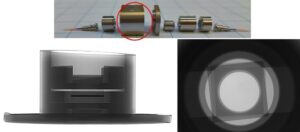
As members of the project team, Tyndall’s Senior Engineering Staff Catriona Kenny and Principal Engineer Finbarr Waldron conducted long-term reliability testing and detailed construction analysis on a wide range of active and passive photonic devices, including laser diodes, photodiodes, UV LEDs, modulators, switches, isolators, and more. Each component was assessed against ESA’s demanding space standards, with risk levels identified for their potential use in the LISA laser system.
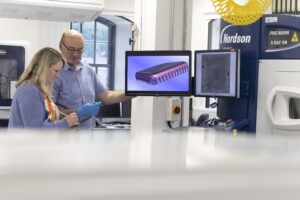
The outcome is a comprehensive dataset that will help ESA make informed decisions about which components to use, ensuring the mission’s laser system performs as intended when deployed.
Finbarr Waldron, Principal Engineer at Tyndall said:
This project showcases the depth of Tyndall’s expertise in photonics and reliability engineering. Space is a very unforgiving environment, and many commercial photonic components are built using materials that may not be suitable for use in space. Our task was to rigorously test and analyse these components to determine whether or not they could withstand the extreme conditions of launch and long-term operation in space.
The project reflects Tyndall’s commitment to research excellence and impactful innovation, showing how international collaboration can push the boundaries of what’s possible in space exploration.