

Tyndall extends its congratulations to the winners of the STS Elionix Scientific Image Competition of Q4 2025!
Open to all researchers at Tyndall, the competition provides a platform to celebrate the artistic side of science, as seen through the microscope. Entrants were invited to submit images that not only reflect their research but also captivate the eye.
The judging panel for this quarter included Professor William Scanlon, CEO, Tyndall; Dr Graeme Maxwell, Head of Specialty Products & Services; Dr Daniela Iacopino, Researcher, MNS; Ursula Morrish, Marketing and Communications Manager
The judges selected three winning entries based on their originality, visual impact, and scientific relevance. The winners of the Q4 2025 competition are:
-
Ehren Dixon – “Cobalt Sugar Gummy“
-
Andres Fontana, Berkay Dogan – “Spiral Starfighter“
-
Ahmed Hashem, Jaekyum Lee, Dr Daniel O’Hare – “Goldfish Chip”
Each winner will receive a €150 Me2You Gift Card, generously sponsored by STS Elionix, in recognition of their contribution to scientific communication and visual storytelling.
Cobalt Sugar Gummy
By Ehren Dixon, Electrochemical Materials & Energy Group
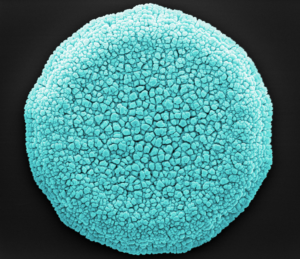
In electroplating, you have the ability to deposit a wide variety of metals and alloys, but it sometimes doesn’t plate the way you want!
In plating alloys, you have to take into consideration that the plating parameters may be widely different to that any of the individual metals, leading to some trial and error where you can get some very interesting formations!
This sugar coated gummy (jelly sweet), is actually a test plate of a Cobalt alloy that has gone a bit awry, but nonetheless looks very appetizing! (Just don’t eat it!)
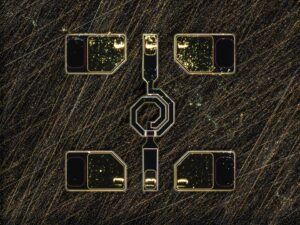
Spiral Starfighter
By Andres Fontana, Berkay Dogan, Advanced RF Technologies Group
Goldfish Chip
By Ahmed Hashem, Jaekyum Lee, Dr Daniel O’Hare, MCCI
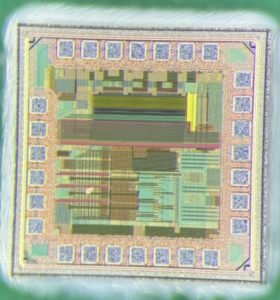
This microscope image shows a silicon chip that measures only 1 mm × 1 mm, making it one of the smallest chips developed for controlling pixels in advanced imaging systems. The chip contains the control circuitry of a three-dimensional (3D) CMOS image sensor, where different stacked layers are used to manage sensing, processing, and control separately. It also contain one of the smallest ADCs, PMUs and RDVs. This work is part of ongoing research at Tyndall National Institute, focused on developing ultra-miniaturized image sensors for biomedical endoscopy applications. By shrinking the control circuitry while preserving the operation, the research supports higher pixel densities, lower power consumption, and improved image quality, all within extremely tight size constraints required.