

Tyndall has announced the recipients of the prestigious Wrixon Bursaries for 2025, recognising outstanding postgraduate research and supporting international collaboration. Five students have been honoured with Research Excellence Bursaries for pioneering work in areas ranging from next-generation wireless networks and energy-efficient computing to integrated photonics and advanced medical imaging. In addition, two students received Wrixon Travel Bursaries to enable international research visits.
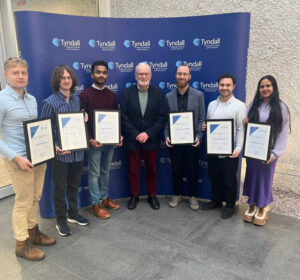
The bursary awards are made possible through the generosity of Professor Gerry Wrixon, past President of UCC, and a leading member of the team that founded Tyndall, formerly known as the National Microelectronics Research Centre (NMRC).
Congratulating the awardees, Professor William Scanlon, CEO, Tyndall, said:
The Wrixon Bursaries reflect Tyndall’s dedication to supporting the next generation of researchers and innovators. These students are tackling challenges in the areas of communications, computing, healthcare, and photonics. Their work demonstrates the innovation and impact that Tyndall strives to achieve, and I extend my warmest congratulations to them all.
Wrixon Research Excellence Bursary Winners:
Zixiao Zhang
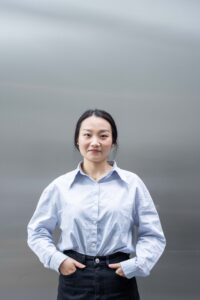
Zixiao’s research is paving the way for future wireless communication systems by developing compact, energy-efficient RF filters using special resonator arrays that can be “modulated” in space and time. These multi-functional components combine filtering, phase shifting, and signal routing in a single device, reducing size and cost while enabling adaptable RF front-ends for 6G networks.
Debismita Dutta
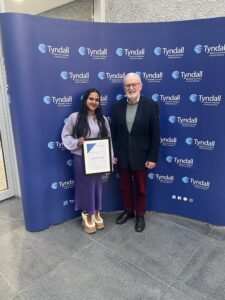
Debismita is tackling the energy restrictions in modern computing by engineering ferroelectric materials for ultra-low-power memory and neuromorphic systems. Her work introduces spiral defect structures to reorient polarisation and reduce switching energy four-fold, alongside a novel 3D X-ray analysis method to map complex defects, advancing scalable, energy-efficient devices.
Tommy Murphy
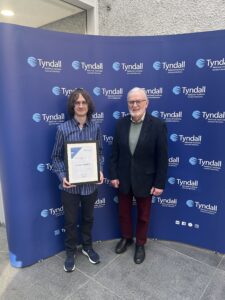
Tommy’s research enhances integrated photonics through improved quantum nanostructures such as quantum dots and wells. He developed QUDOS, an open-source simulator for predicting optical properties, and solved a decades-old puzzle in quantum well intermixing. These breakthroughs enable smarter design of high-speed photonic components for data communication.
Cian O’Donnell
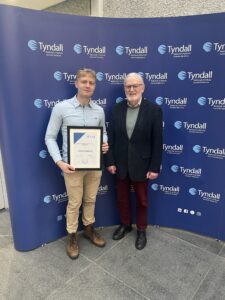
Cian is developing millimetre-scale wireless implants for real-time tumour tracking, using miniature inductive power transfer and low-power sensing. This innovation promises to improve surgical precision and patient outcomes by enabling accurate, continuous monitoring during procedures.
Dario Angelone
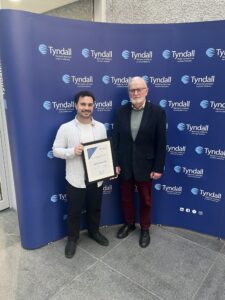
Dario’s project introduces EndoCam, a tiny SPAD-based fluorescence lifetime imaging (FLIm) camera that fits into endoscopes for real-time imaging inside the body. His work demonstrates FLIm for tumour tissue analysis and creates the first chip-on-tip FLIm micro-camera for clinical use, paving the way for advanced diagnostic tools.
Wrixon Travel Bursary Winners
Simone Innocente
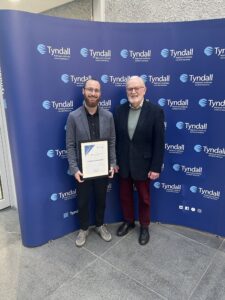
Simone is applying advanced machine learning to interpret complex optical spectroscopy data, improving diagnostic accuracy in pathology. By developing standardised data-processing tools and combining features from multiple techniques, his work enhances both the quality and precision of disease detection. Simone will travel to Florida International University in Miami and will be working in the Medical Photonics Laboratory.
Rajan Bharti
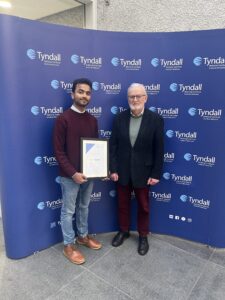
Rajan’s project seeks to improve the efficiency of tiny InGaP micro-LEDs by tackling defects that waste energy instead of producing light. These losses occur at the interface with Al₂O₃, likely due to missing phosphorus atoms. Current research has identified the electrical signature of these defects, but their full behaviour remains unclear. A planned study will use advanced spectroscopy techniques to map these defects in detail, revealing their energy levels and how they interact with light. The findings will guide methods to suppress these defects, boosting LED performance and enabling more efficient, miniaturised optoelectronic devices for future technologies. Rajan will travel to Ohio State University and will be working in the Electronic Materials & Devices Lab.