

Tyndall National Institute, based at University College Cork, is proud to announce the launch of eFLOWER, a major new EU funded research initiative that will develop the next generation of sustainable, high performance electronic textiles (etextiles) for health and wellbeing applications.
Electronic waste is one of the fastest growing waste streams worldwide, with more than 50 million tonnes generated every year, most of which is never properly recycled. At the same time, the global textile industry produces around 92 million tonnes of waste annually. Etextiles sit at the intersection of these two challenges, combining electronic and textile waste into a single, rapidly expanding problem. With the etextiles market expected to reach approximately $16 billion by 2030, the environmental impact of wearable electronics will only intensify unless sustainable solutions are developed.
Technologies emerging from e‑FLOWER offer a pathway to change this trajectory. By introducing bio‑based materials, circular design principles, and recyclable electronic components, the project has the potential to reduce CO₂ emissions by hundreds of thousands of tonnes per year and save billions of cubic metres of water. Today’s electronics are rarely designed for disassembly or reuse; e‑FLOWER aims to reverse this trend by enabling devices that can be repaired, reused, or fully recycled, extending product lifetimes and dramatically reducing waste.
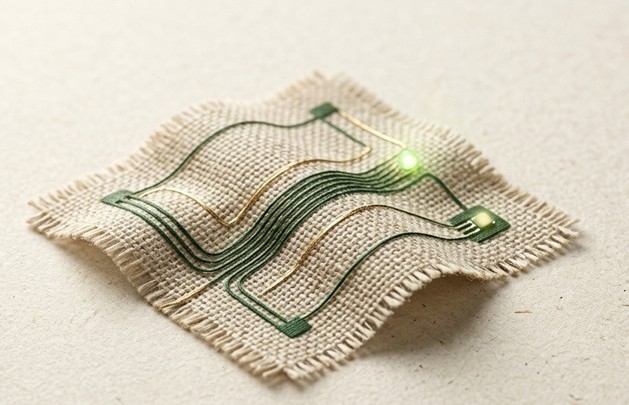
The project will develop solutions ready for industrial scale-up, strengthening Europe’s textile value chain and supporting the EU’s broader green and digital transition.
Commenting on these solutions, Dr Daniela Iacopino, e-FLOWER Coordinator and Principle Research Scientist at Tyndall said
“We aim to overcome current technological and environmental barriers in e-textiles and drive the development of next generation solutions that combine performance and robustness, with comfort, inclusiveness, sustainability and circularity. This will be achieved through the development of fully integrated textile sensors – glucose, lactate, ECG and more for LAND (cycling, running etc), WATER (swimming, diving) and SPACE environments”.
By aligning with European ambitions for sustainable industry, advanced materials, and circular design, e-FLOWER will help shape a future where wearable technologies are not only more capable but also significantly greener.
Bringing together world-leading expertise from a global consortium in materials science, advanced manufacturing, and wearable systems, eFLOWER will redefine how smart textiles are designed, produced, and recycled. The project integrates Safe and Sustainable by Design (SSbD) principles from the outset, ensuring that technological innovation is matched by environmental responsibility.
e‑FLOWER introduces a holistic approach to e‑textile development by combining:
- Bio‑based adhesives, inks, and encapsulants engineered for stretchability, durability, and recyclability
- Modular textile architectures that enable repair, reuse, and efficient material recovery
- Energy efficient 3D and screen printing processes for scalable, low impact manufacturing
- Seamless integration of sensors, antennas, energy harvesting, and storage directly into fabrics
This integrated strategy will deliver smart textiles that offer comfort, performance, and circularity — without compromise.
With e-FLOWER, Europe is planting the seeds of a sustainable wearable future and the impact will continue to grow for years to come.