

From lab fellows to life partners.
Designed to bring researchers together across countries, cultures and disciplines, the Marie Skłodowska-Curie Actions (MSCA) programme has sparked countless collaborations and lifelong connections in 3 decades.
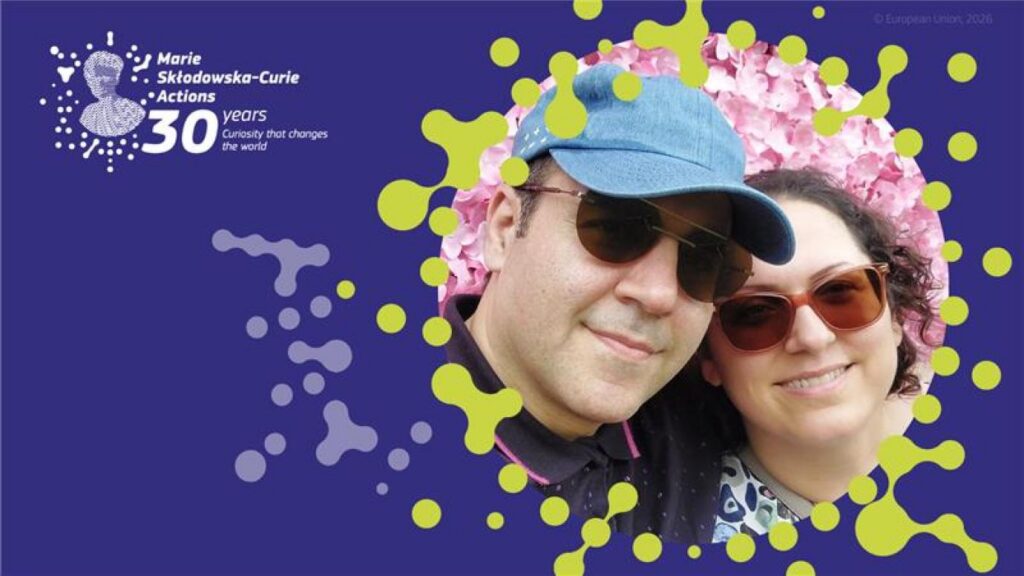
In the case of Somayyeh Bozorgzadeh and Hassan Hamidi, two electrochemists who study the development of health monitoring sensors at Tyndall, here in Cork, it also happens to frame a love story that began in a lab 19 years ago and continues to blossom today.
As they grew from simple lab fellows into life partners, their shared path in research brought them to win two MSCA grants with their own projects. Today, they are beyond grateful to the programme for boosting their research careers and facilitating their family’s relocation.
Ahead of Valentine’s Day, we spoke to them both to find out how much chemistry runs between them, how science brought them much more than a lasting career and what it’s like to be a couple in research nowadays.
How did it all get started?
Somayyeh
We met 19 years ago as PhD students at the Institute for Advanced Studies in Basic Sciences (IASBS) in Zanjan, Iran, when we both joined the same research group in electrochemistry. At first, we were just colleagues, but we quickly grew fond of each other. We’re from different parts of Iran so we got to exchange on our cultures and we built mutual admiration for each other’s work. We were working closely every day and we grew closer little by little. This is how it started – but Hassan has a slightly different version!
Hassan
I love telling that story and Somayyeh loves to deny it! We had already been growing closer while working in the lab and I had been invited to a student party that Somayyeh and fellow students were hosting. She was attending to all the guests, but I felt like she was paying particular attention to me… And without going into detail, that’s when our love story really began.
How did you both decide to apply for MSCA?
Hassan
During the pandemic, we were stuck at home and had more time on our hands. We had been encouraged to apply for the MSCA grants, but we knew it was very competitive and we weren’t very confident our proposals would make the cut. We both decided to try anyway for the 2020 call. My proposal was selected, and so I received the MSCA grant first.
Somayyeh tried again, and in 2022 she finally made it! Because we had been working under pandemic restrictions for a while, it was even more rewarding to be selected and be able to go back to research fully and independently. We received the good news on Valentine’s Day and were able to go out for dinner in Cork that evening and celebrate with our daughter.
Before being awarded the MSCA grant, I didn’t fully understand the value and the extent of it. After moving to Cork and being able to connect with international researchers, I truly realised how much of a boost this funding would be to our careers!
How did becoming MSCA researchers change your life?
MSCA is all about mobility, knowledge transfer and building a community.
Read the full interview here – Love at first science: From lab partners to MSCA power couple