

Tyndall extends its congratulations to the winners of the STS Elionix Scientific Image Competition of Q3 2026!
Open to all researchers at Tyndall, the competition provides a platform to celebrate the artistic side of science, as seen through the microscope. Entrants were invited to submit images that not only reflect their research but also captivate the eye.
The judging panel for this quarter included Professor William Scanlon, CEO, Tyndall; Dr Graeme Maxwell, Head of Specialty Products & Services; Dr Daniela Iacopino, Researcher, MNS; Ursula Morrish, Marketing and Communications Manager.
The judges selected three winning entries based on their originality, visual impact, and scientific relevance. The winners of the Q3 2026 competition are:
- Luca Colavecchi, Brian Corbett, ‘The Tyndall Chalice’
- Fabian Noel, ‘Monuments in the Sand’
- Berkay Dogan, Andrés Fontana, ‘The Helmet’
Each winner will receive a €150 Me2You Gift Card, generously sponsored by STS Elionix, in recognition of their contribution to scientific communication and visual storytelling.
Ferroelectric Flag Pole
By Luca Colavecchi, Brian Corbet, III-V materials and devices
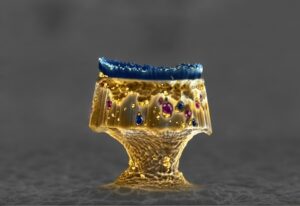
This golden semiconductor chalice is the result of a double dry etching process to form a mesa structure, the building block of devices such as micro-LEDs, photodiodes and solar cells. Carving a mesa damages its surfaces, creating defects that make charge carriers recombine uselessly, wasting energy and hurting performance.
A possible remedy is a second, gentler chlorine plasma etch that removes just a few nanometres of damaged material. Here, the etch was far too aggressive: it attacked every surface almost indiscriminately, undercutting the pillar and leaving this rough-surfaced, chalice-shaped relic.
A failed experiment, and a reminder of how delicate nanofabrication can be.
‘Monuments in the Sand’
By Fabian Noel, Epitaxy and Physics of Nanostructures (EPN)
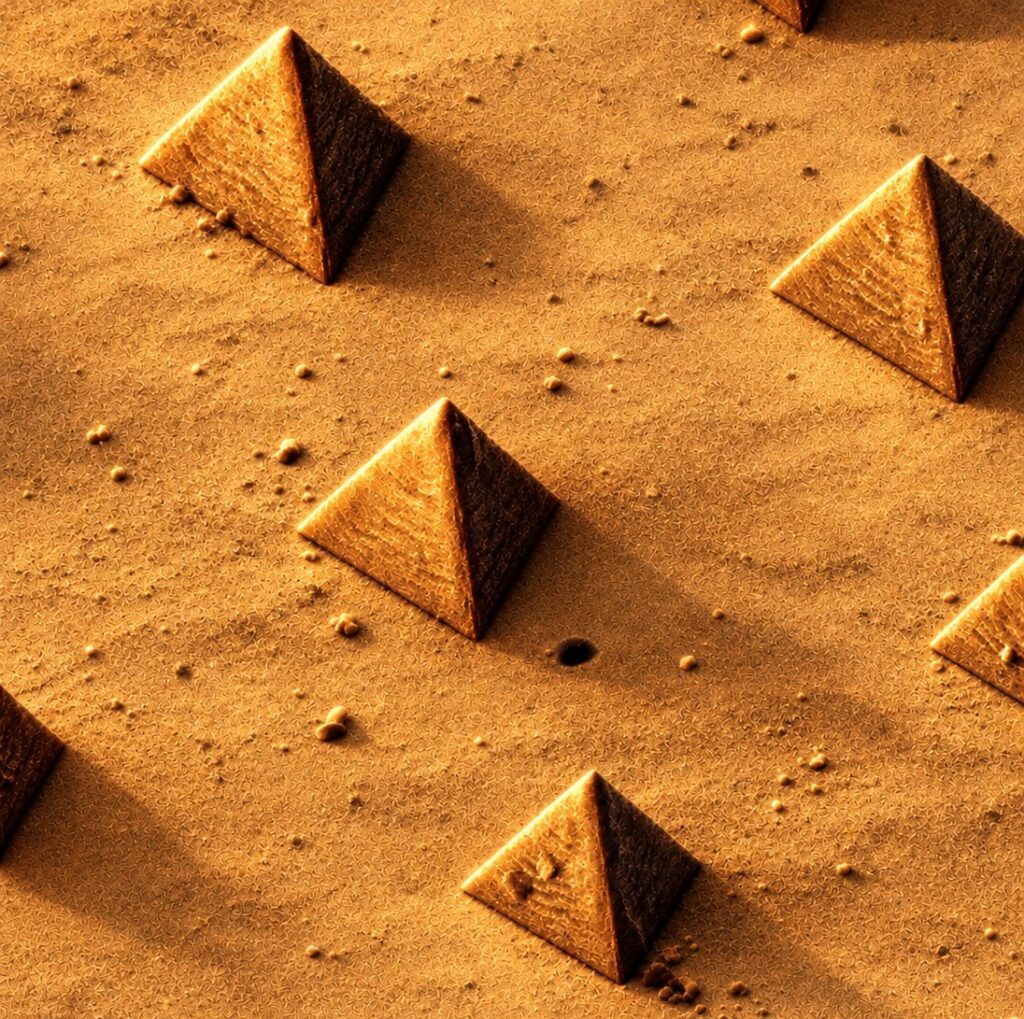
Patterning and etching of GaAs 111B substrate produces downward facing tetrahedral recesses. Epitaxial growth followed by inversion and selective etching results in these majestic structures. This process is the basis for realization of pyramidal quantum dots. InGaAs and GaAs QDs grown and processed using this technique have proven to be relatively brighter than as-grown samples.
The Helmet
By Berkay Dogan, Andrés Fontana, Advanced RF Technologies Group (ART)
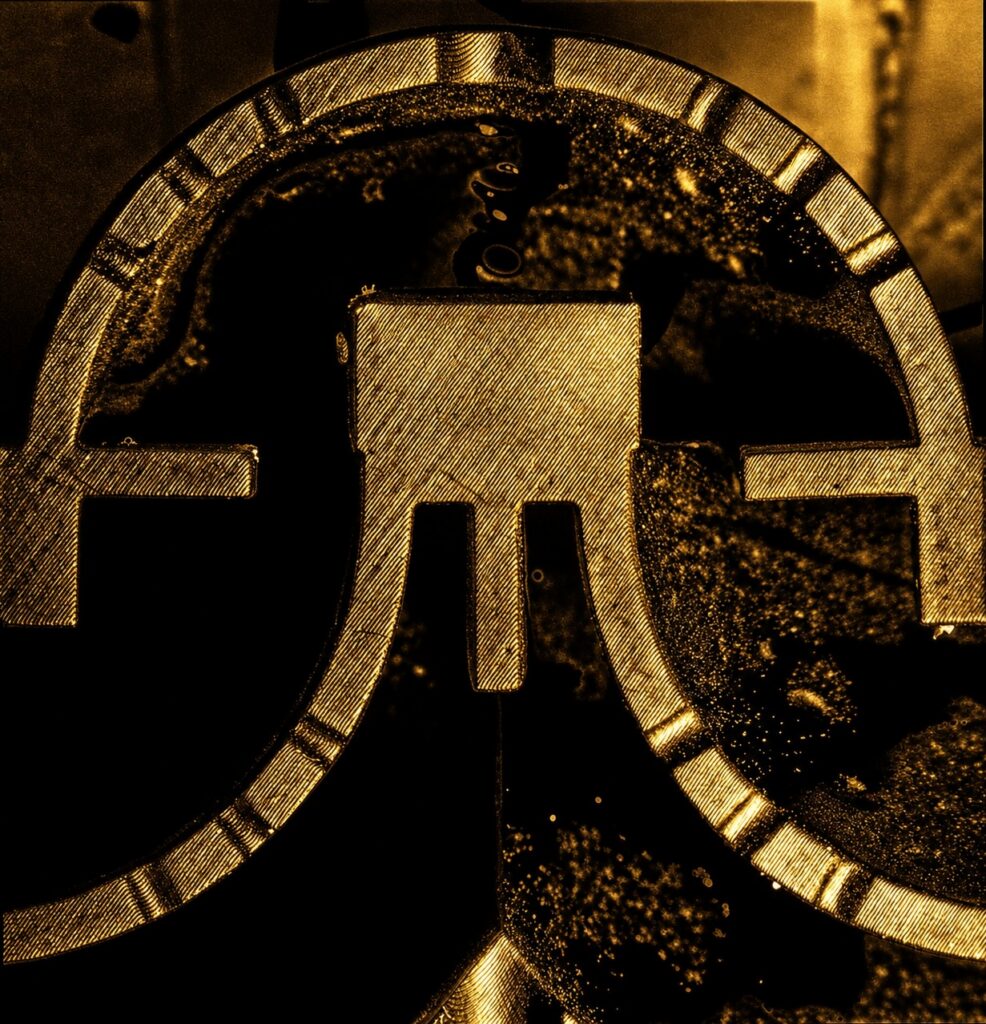
This image captures the cross-section of a 3D-printed, nested hemispherical dual-channel RF filter. Its carefully designed 3D geometry enables two independently reconfigurable filtering channels within a single monolithic structure.
Echoing the legendary Spartan helmet, this architecture electromagnetically shields the two nested resonant cavities, achieving extraordinary inter-channel isolation of up to 102.4 dB.
Compared to its bulky and heavy CNC-machined metallic counterparts, this helmet weighs less than 45 grams, always ready for the radio-frequency battlefields of next-generation communication systems.