

Researchers from Tyndall National Institute have unveiled a major breakthrough to optically powering miniature biomedical devices. The devices, using light, are paving the way for less invasive and more efficient technologies for use deep within the tissue of the human body. Tyndall is a partnership between the Department of Further and Higher Education, Research, Innovation and Science and University College Cork.
The research titled ’Towards all optically powered miniature devices in remote locations of the body’, published in Optics Letters, explores how optical power delivery can enable devices to operate in remote or hard-to-access biological environments, where traditional electrical power sources are impractical.
The first-of-its kind chip-on-tip microcamera at the device tip is powered entirely by light delivered down an optical fibre onto a customised multi-segmented photovoltaic cell.
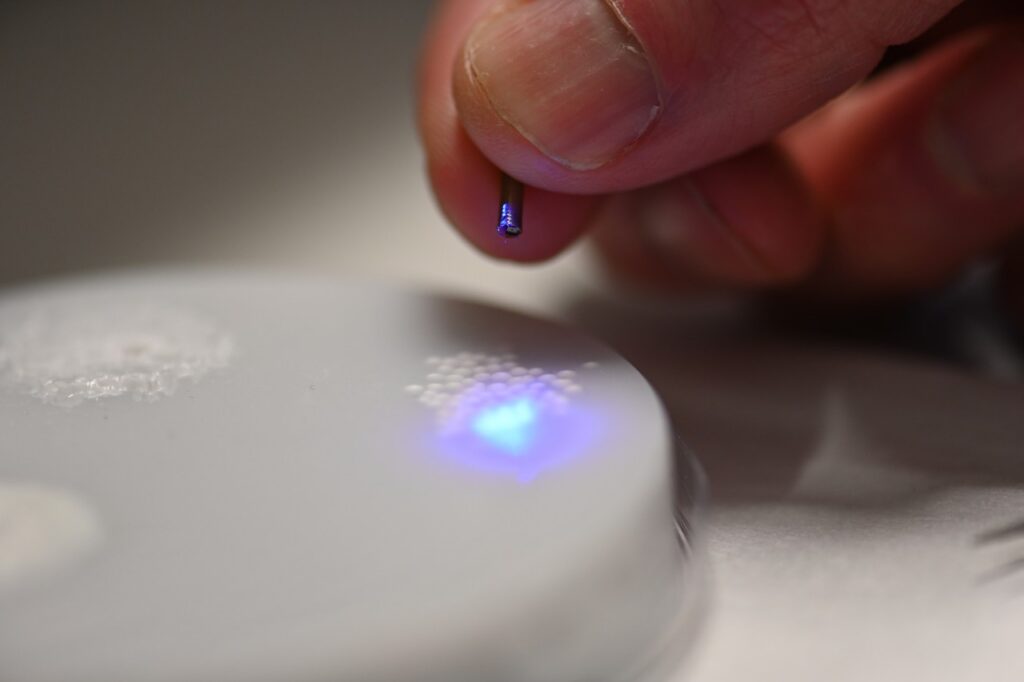
By eliminating the need for wires or batteries, the research demonstrates the potential for fully optically powered systems that are smaller, safer, and more adaptable. These advances could significantly enhance applications such as in-body sensing, imaging, and targeted therapies, providing access in hard to access parts of the body e.g., narrow blood vessels.
This research is rooted in three of Tyndall’s strategic research programmes, Biophotonics, Photonic Devices and Photonics Packaging and Systems Integration, whom together are advancing new capabilities. By combining expertise in biophotonics with advanced device integration, Tyndall researchers are helping to accelerate the development of practical, real-world solutions for next-generation medical technologies.
Following on from this work, the Biophotonics team have further developed this photonics integration research through their most recent publication titled ‘Chip-on-tip fluorescence lifetime imaging micro-camera toward endoscopic applications’. This is the first chip-on-tip fluorescence lifetime imaging (FLIM) micro-camera at an endoscopic scale, 4 mm outer diameter, with a miniaturised SPAD array detector, integrated optics and fibre-delivered excitation, resolving features below 30 µm.
Bringing together expertise from Tyndall’s strategic research programmes, the University of Edinburgh, and IPIC, the Research Ireland Centre for Photonics, spin‑out BioPixS, this collaborative effort has achieved two landmark “firsts” in miniature photonics integration. The work not only advances the development of underlying semiconductor and photonic technologies but also ensures that devices can be robustly packaged and reliably deployed in complex biological environments.
This integrated approach is critical to translating early-stage research into clinically viable solutions. It also demonstrates that the Institute can design, develop, integrate and power functional semiconductor and photonic components at this tiny footprint for biomedical use, positioning Tyndall as a leader in miniature photonics integration.
Dr Sanathana Konugolu Venkata Sekar, Head of FAST-BioPhotonics, Tyndall commented
“This work represents a significant step in translating semiconductor and photonics research into clinically relevant technologies. Having demonstrated fully optically powered operation in controlled environments, we are now focused on progressing towards pre-clinical and in vivo validation. This transition is essential to proving real-world viability in complex biological environments. At Tyndall, our mission is to advance semiconductor research from materials through to fully integrated systems, and this breakthrough exemplifies how we are delivering that vision, transforming research into practical, minimally invasive solutions for healthcare.”
Prof. Peter O’Brien, Director of Advanced Packaging at Tyndall, said that “the ability to design components and build functional systems using state-of-the-art packaging processes and equipment demonstrates Tyndall’s leadership in addressing emerging challenges in medical device technologies, particularly the trend towards increasingly functional and miniaturised systems”.
Brian Corbett, Head of III-V materials and device at Tyndall, noted that “our deep expertise in photonic device design and fabrication enables a wide variety of ultra-compact components serving a wide range of new and exciting applications with significant commercial potential”.