

Tyndall National Institute, based at University College Cork (UCC), was honoured to welcome An Taoiseach Micheál Martin and the Prime Minister of the United Kingdom, Sir Keir Starmer, to showcase Tyndall’s cutting-edge research and UK-Ireland collaborations in sustainable semiconductor technologies.
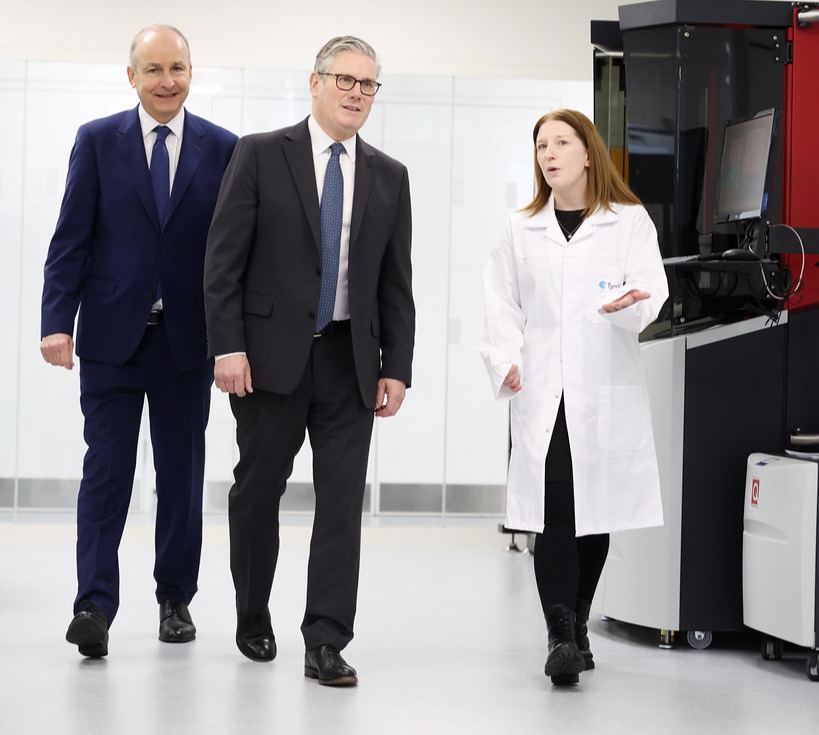
During their visit, the delegation engaged with Tyndall researchers, postgraduate students, and industry partners, learning about the breakthrough technologies in sustainable AI, digital healthcare, energy efficient systems, and next-generation communications. A guided tour of Tyndall’s state-of-the-art laboratories provided firsthand insight into the institute’s impact on global scientific and societal challenges.
Speaking about the visit, Professor William Scanlon, CEO, Tyndall, said:
“Tyndall has a proud track record of collaboration with academic and industry partners across the United Kingdom, and it was a privilege to highlight some of this research to the Prime Minister, Sir Keir Starmer, and An Taoiseach, Micheál Martin. This visit allowed us to showcase our state-of-the-art facilities, our world-class researchers, and our talented postgraduate students. Tyndall’s leadership in semiconductor innovation, from materials to systems, is an important driver for strengthening research links between Ireland and the UK in addressing global challenges – from sustainable AI and energy efficiency to next-generation communications and digital health. As Ireland strengthens its position in sustainable semiconductor innovation, Tyndall remains committed to being a beacon for talent, technology, and transformative impact.”
Research Highlights
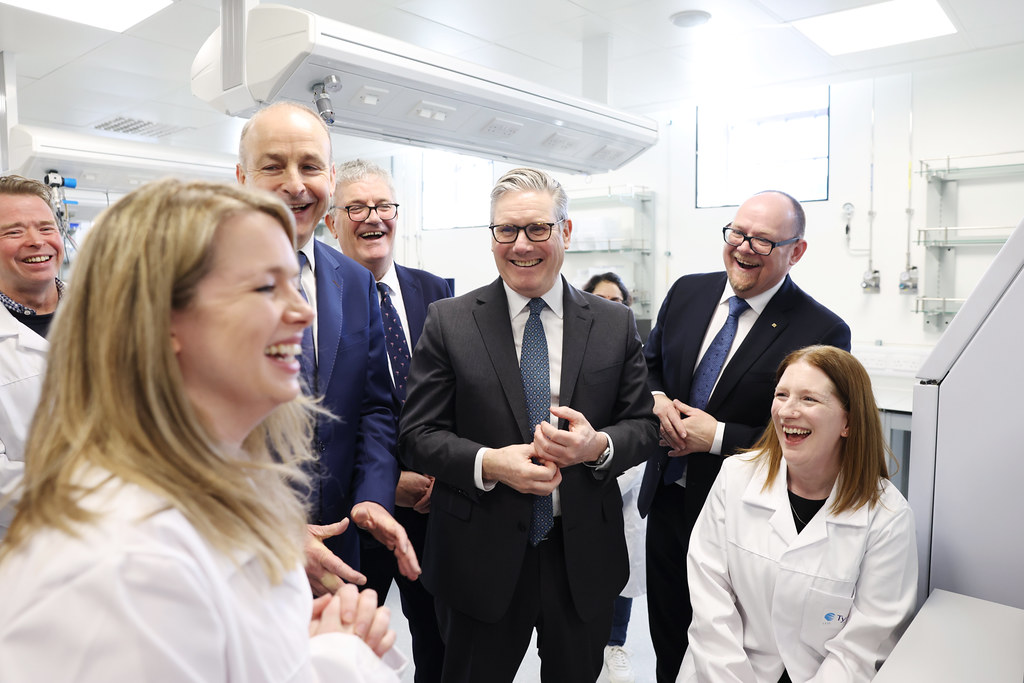
The delegation met Dr Lynette Keeney, Principal Scientist at Tyndall, and Dr Shelly Conroy, Associate Professor at Imperial College London, who presented their collaborative research on ultrathin materials with both magnetic and electric properties. These materials, measured at less than 10 nanometres thick, have the potential to enable a universal, energy efficient computer memory. By analysing their behaviour using advanced nanoscale imaging tools, the team is developing technologies capable of storing more data in smaller spaces while dramatically reducing energy consumption.
An Taoiseach and the Prime Minister also met Brian Corbett, Principal Researcher, Tyndall, Dr Mark Gubbins, Senior Director, Seagate and Julia Coym, Director, Seagate. Tyndall has a 15-year photonics driven collaboration with Seagate, which has advanced the push for higher density magnetic data storage. What began as early research has since matured, greatly enabling the data storage product and technology roadmap by incorporating ultraminiaturised components produced through highly complex fabrication processes. The expertise developed through this partnership is also informing progress in emerging fields such as quantum technologies and AI.
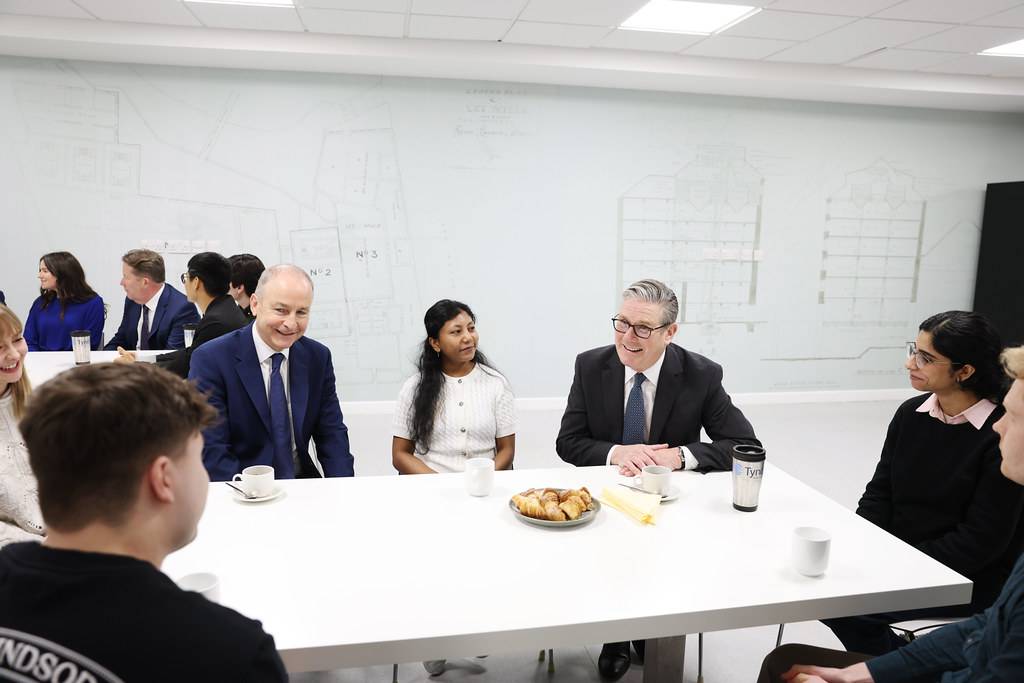
A group of Tyndall PhD students also shared insights into their research activities, reflecting the depth and diversity of talent contributing to Ireland’s leadership in semiconductor and photonics innovation.
Amna Tiwana, PhD Student at Tyndall said:
“With 165 PhD students from 24 different nationalities here at Tyndall, it was an honour to be one of the postgraduate researchers chosen to meet An Taoiseach and the UK Prime Minister. I had the chance to speak about my research in advanced digital signal processing technologies, enabling high‑speed wireless access for future 6G networks. Having leaders at this level show such genuine interest was incredibly motivating. It really reinforced the importance of what we’re doing and the potential our research has to shape the technologies of the future”.
Ed Miliband, Secretary of State for Energy Security and Net Zero, and Darragh O’Brien TD, Minister for Transport and Minister for Climate, Energy and the Environment, were also in attendance and met with representatives from Tyndall related spin‑outs and start‑ups, showcasing innovations ranging from radiation‑measurement technologies to virtual‑reality advances and next‑generation connectivity solutions.
They engaged with Tyndall energy researchers Dr Pádraig Lyons and Ruchi Agrawal, who outlined their work on accelerating Ireland’s decarbonisation, particularly in energy intensive sectors such as pharmaceuticals, data centres and semiconductor manufacturing. They highlighted Tyndall’s efforts to improve the energy efficiency of computing and data‑centre technologies, noting that Ireland’s increasingly green electricity system makes it an ideal location for these facilities, especially as growing global demand for data and AI means relocating them to less sustainable grids would lead to higher CO₂ emissions.
Strengthening Ireland–UK Research Collaboration
The visit coincided with the announcement of a new Memorandum of Understanding between UK Research and Innovation (UKRI) and Research Ireland. The agreement expands bilateral collaboration in strategically important areas such as advanced connectivity, materials science, quantum technologies, and the creative industries. Both organisations welcomed the MoU as a significant step forward in accelerating talent development, knowledge exchange, and cross-border research partnerships.