

Tyndall extends its congratulations to the winners of the STS Elionix Scientific Image Competition of Q2 2026!
Open to all researchers at Tyndall, the competition provides a platform to celebrate the artistic side of science, as seen through the microscope. Entrants were invited to submit images that not only reflect their research but also captivate the eye.
The judging panel for this quarter included Professor William Scanlon, CEO, Tyndall; Dr Graeme Maxwell, Head of Specialty Products & Services; Dr Daniela Iacopino, Researcher, MNS; Ursula Morrish, Marketing and Communications Manager.
The judges selected three winning entries based on their originality, visual impact, and scientific relevance. The winners of the Q2 2026 competition are:
- Lynette Keeney, ‘Ferroelectric Flag Pole’
- Sheshank Biradar, Nikolay Petkov, Giorgos Fagas, ‘Event Horizon’
- Anina Anju Balaraman, Russell Duane, Ruth Houlihan, ‘Bourbon Biscuits: A Sweet Disguise for Smart Engineering’
Each winner will receive a €150 Me2You Gift Card, generously sponsored by STS Elionix, in recognition of their contribution to scientific communication and visual storytelling.
Ferroelectric Flag Pole
By Lynette Keeney, Advanced Materials & Surfaces Group
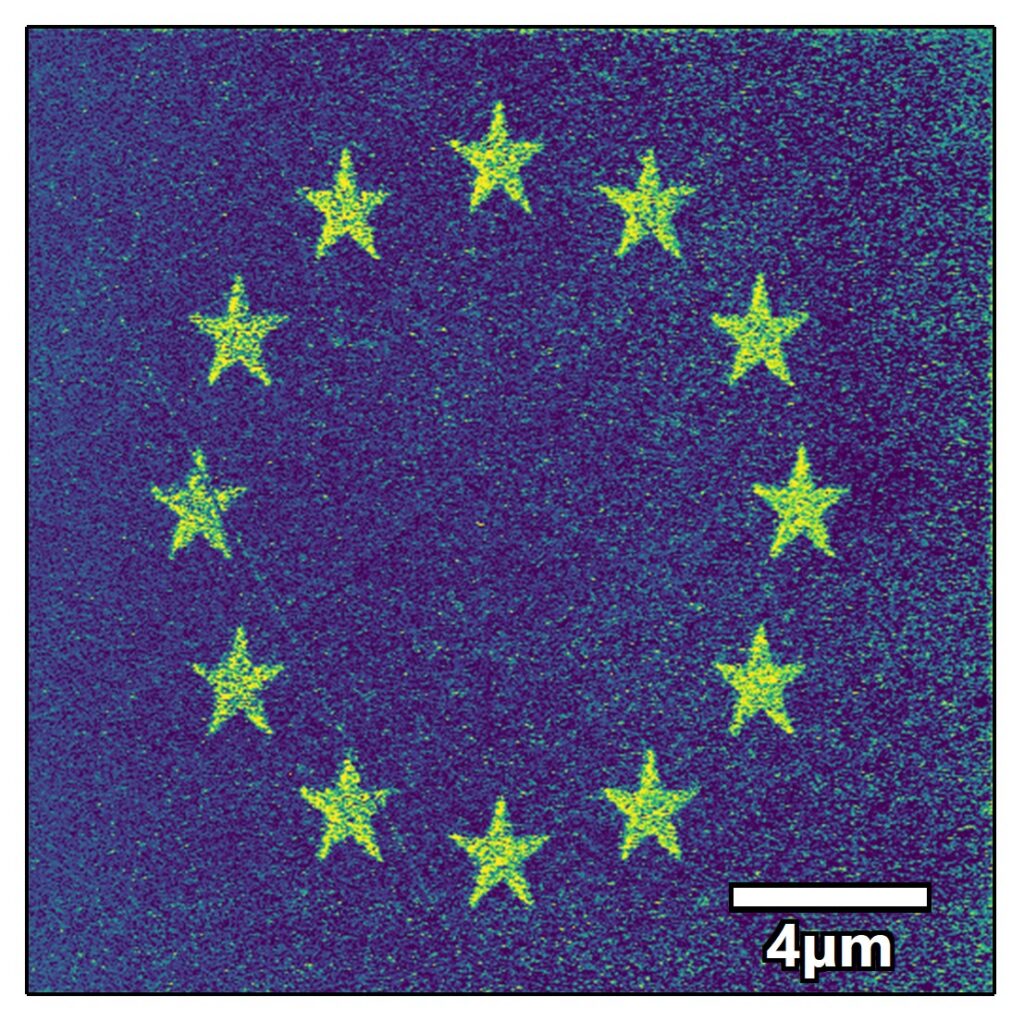
This image demonstrates the ability to write and store information in materials that are thousands of times thinner than a human hair.
Within the film are nanoscale regions whose polarisation can be oriented in different directions. By applying a small electrical voltage through a scanning probe tip, these regions can be switched into a chosen state. Crucially, they remain stable even after the voltage is removed, enabling information storage in binary form, such as zero and one.
In this example, a 7-nanometre-thick film has been patterned to form the EU flag by selectively switching different regions. The result is a simple but striking demonstration of how information can be encoded at the nanoscale through ferroelectric poling; a true “Ferroelectric Flag Pole”. This concept was demonstrated to the President of the European Commission during a recent visit to Tyndall.
‘The Event Horizon’
By Sheshank Biradar, Nikolay Petkov, Giorgos Fagas, Quantum Electronic Devices, (QED) Group
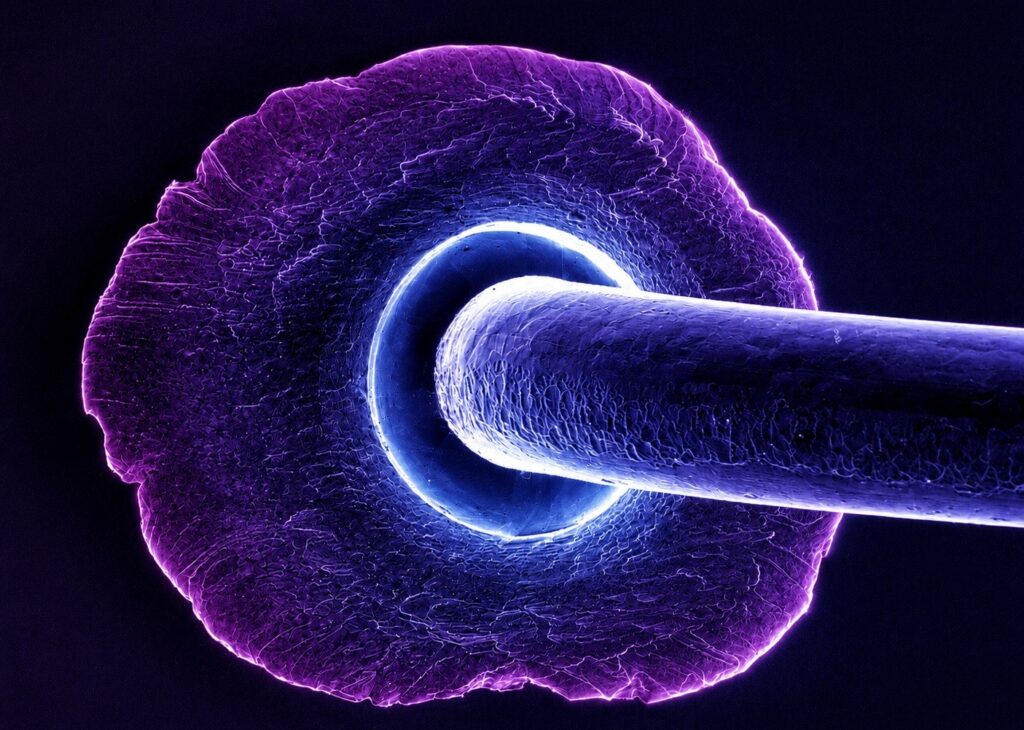
A glowing ring surrounds a dark centre, making the image look like the edge of a black hole.
However, this is not a distant galaxy. It is a microscopic wire bond captured using scanning electron microscopy, showing where a fine metallic wire connects to a titanium nitride resistor device and forms an important electrical contact.
The colourisation gives the image a cosmic appearance and turns a normal engineering feature into something mysterious.
Just as an event horizon represents a boundary between the known and the unknown, this tiny interface marks the point where invisible electrical signals begin their journey. The image shows that discovery is not only found in outer space, but equally fascinating worlds can also be seen in structures measured in nanometres.
Bourbon Biscuits: A Sweet Disguise for Smart Engineering
By Anina Anju Balaraman, Russell Duane, Ruth Houlihan, IPES
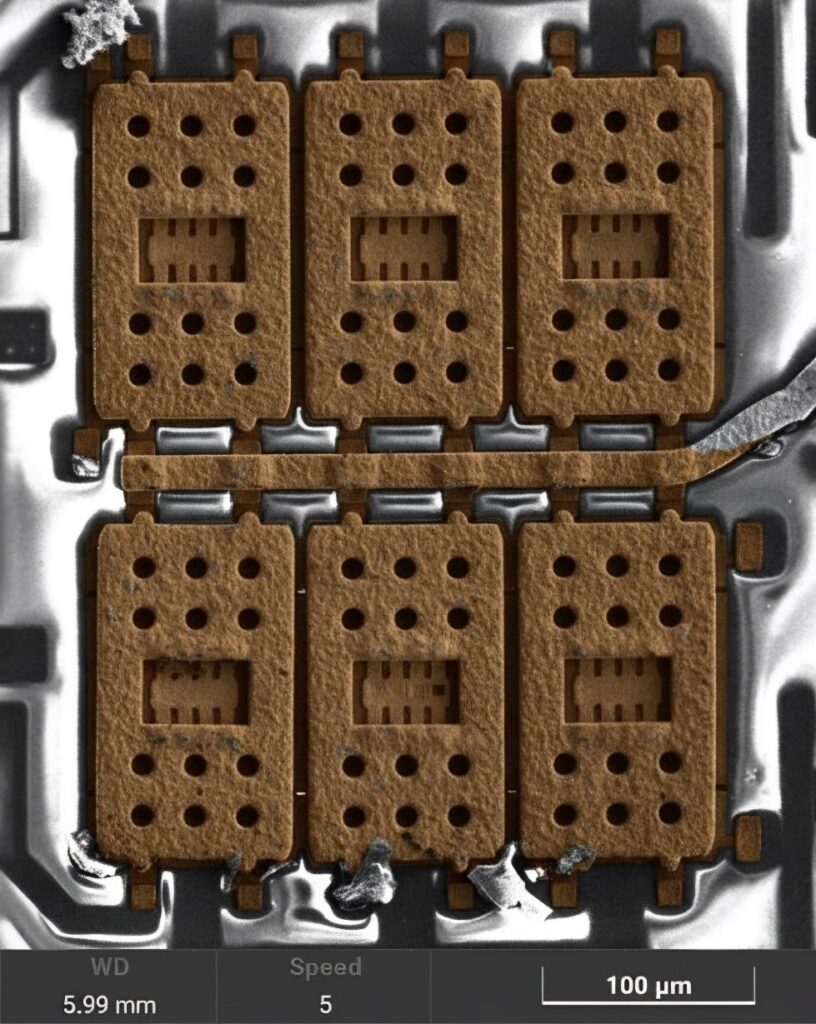
A closer look reveals that this “tray of Bourbon biscuits” is not a sweet treat, but a microscopic landscape of RF MEMS switches fabricated by Analog Devices, Inc. (ADI), viewed through a scanning electron microscope.
Much like a Bourbon biscuit hides its chocolate filling beneath a familiar crispy exterior, these tiny devices conceal complex engineering within a compact footprint. At Tyndall, we study the reliability of these switches to ensure they can withstand challenging operating environments. Behind their biscuit-like appearance is precision engineering at the microscale, enabling reliable control of radio-frequency signals for future communication systems.