

Tyndall National Institute has announced the recipients of the prestigious Wrixon Bursaries for 2026, recognising outstanding postgraduate researchers and supporting international research collaboration.
Three students have been awarded Wrixon Research Excellence Bursaries for pioneering work in advanced materials, semiconductor technologies and smart diagnostics, while three researchers have received Wrixon Travel Bursaries to support international research visits in Germany, Australia and Portugal.
Congratulating the awardees, Professor William Scanlon, CEO, Tyndall, said:
The Wrixon Bursaries recognise some of the most promising early-career researchers within our community. This year’s recipients are advancing knowledge in healthcare, advanced materials, semiconductor, and quantum technologies, while also building valuable international research collaborations. I congratulate each of the awardees and look forward to seeing the impact of their work in the years ahead.
The bursary awards are made possible through the generosity of Professor Gerry Wrixon, past President of UCC, and a leading member of the team that founded Tyndall, formerly known as the National Microelectronics Research Centre (NMRC).
Wrixon Research Excellence Bursary Winners:
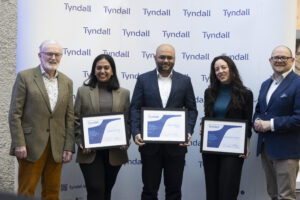
Martina Piletti
Martina’s research explores the potential of multifunctional carbon dots, a novel nanomaterial with applications across security, sensing and sustainable packaging. By developing a single carbon-dot system that can be adapted for fluorescent inks, antibiotic detection and active food packaging, her work demonstrates how advanced materials can address diverse real-world challenges. Her research highlights the versatility of carbon nanomaterials and their potential to support innovative, low-cost and environmentally friendly technologies.
Md Ridwan Adib
Ridwan is developing smart electrochemical nanosensors that can non-invasively monitor calf health through saliva analysis. His innovative platform measures multiple health indicators, including glucose, lactate and pH, while overcoming the challenges associated with saliva-based diagnostics. By enabling earlier disease detection and supporting more responsible antibiotic use, this research has the potential to significantly improve animal health and welfare in the agricultural sector.
Aashi Gupta
Aashi’s research focuses on next-generation semiconductor technologies that could help overcome the scaling limitations of conventional silicon electronics. By developing low-temperature fabrication techniques and advanced laser-processing methods for two-dimensional semiconductor materials, her work supports the integration of these promising materials into future chip architectures. The research contributes to more powerful and energy-efficient electronic devices and supports the goals of Europe’s semiconductor innovation ecosystem.
Wrixon Travel Bursary Winners:
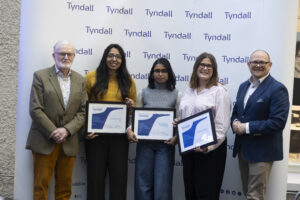
Kaynat Alvi
Kaynat’s research investigates silicon colour centres for emerging quantum technologies, including quantum networks and secure communications. Through a research visit to Dr Yonder Berencén’s group at Helmholtz-Zentrum Dresden-Rossendorf (HZDR) in Germany, Kaynat will study the optical and spin properties of silicon quantum emitters and explore how material characteristics influence their performance. The project aims to support the development of future quantum photonic devices and single-photon sources.
Louise Frost
Louise’s PhD research explores how advanced light-based techniques can improve the performance of upconversion nanoparticles for deep-tissue imaging applications. Through a research visit to the Centre of Light for Life at The University of Adelaide, hosted by Professor Kishan Dholakia, she will investigate innovative microscopy approaches that could enhance imaging contrast in biomedical applications. The work will help bridge fundamental photonics research and practical healthcare technologies.
Sumedha Chanda
Sumedha is developing advanced optical imaging tools for gastrointestinal diagnostics and surgical guidance. During a research visit to the Champalimaud Foundation in Portugal under the supervision of Dr João Lagarto, she will work on translating fluorescence lifetime imaging (FLIm) technologies from the laboratory into clinical settings. The collaboration will help advance next-generation endoscopic imaging tools and strengthen Tyndall’s capabilities in medical imaging research.