

Professor Richard Penty is Professor of Photonics at the University of Cambridge, where he serves as the Head of the School of Technology and as a Deputy Vice Chancellor. An internationally recognised research leader in photonics and quantum communications, he has made significant contributions to the development of high-speed optical networks and communications technologies. He has founded several technology spin-outs and published more than 1000 peer-reviewed research papers. He was formerly Master of Sidney Sussex College and is a Fellow of the Royal Academy of Engineering. He currently serves on the Board of Tyndall National Institute and is widely recognised for his research leadership, innovation and commercialisation of photonics technologies.
On the Tyndall board, Richard brings deep expertise in research strategy, technology innovation and the translation of advanced technologies from laboratory research to real-world application. Drawing on extensive experience across academia, entrepreneurship and industry collaboration, his advice helps strengthen Tyndall’s position at the forefront of semiconductor innovation while supporting the institute’s ambition to deliver research leadership, industrial impact and long-term societal benefit.
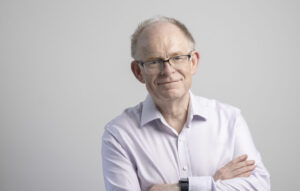
In this Q&A, Richard shares his perspectives on the future of semiconductor technologies, the importance of research translation and industry collaboration, and the role of innovation ecosystems in addressing global challenges. He also reflects on how Tyndall’s strengths in talent, technology and partnerships can help drive its 2030 ambitions and create lasting economic and societal value.
How does your experience in research and innovation help shape Tyndall’s future direction?
Throughout my career, I have worked at the intersection of academic research, technology development and commercialisation. My research in photonics and optical and quantum communications has focused on translating scientific advances into technologies that can address real-world challenges, whether through industrial collaboration, IP licensing or the creation of technology spin-out companies. This experience has reinforced my belief that research achieves its greatest impact when it is connected to clear societal and economic outcomes.
One of the most important lessons I have learned is that innovation depends on strong ecosystems. Breakthroughs rarely emerge from a single person acting as an individual. They come from bringing together researchers, industry partners, entrepreneurs and investors around a particular technological breakthrough. Creating environments where those connections can thrive is essential if we are to address increasingly complex challenges in areas such as semiconductors, communications, digital infrastructure and sustainability.
As a Board member, I aim to draw on my experience leading large academic organisations, developing research strategy, building international partnerships and supporting technology commercialisation. My role on the Board is to help to ensure that Tyndall continues to strengthen its international reputation, attracts outstanding talent and continues to improve on its goal of transforming excellent research into meaningful impact. These capabilities will be increasingly important as Tyndall delivers on its 2030 ambitions and contributes to Europe’s leadership in semiconductor innovation.
What opportunities do you see for Tyndall over the next decade?
The next decade presents a remarkable opportunity for Tyndall to strengthen its position as one of Europe’s leading centres for semiconductor research and innovation. Demand for advanced technologies is growing rapidly across industrial sectors and new technologies that advance communications, artificial intelligence, healthcare, sustainable energy and quantum science are creating significant opportunities for organisations that can combine technological leadership with industry relevance to deliver real-world impact.
Tyndall is well positioned to build on its internationally recognised strengths in semiconductor technology: heterogeneous integration, advanced packaging, advanced materials, next generation communications and system-level semiconductor technologies. These capabilities sit at the heart of many of the innovations that will underpin future economic growth.
Having been involved in the creation of technology spin-outs during my career, I aim to support Tyndall’s ambition to move beyond largely project-based commercialisation towards a deliberate and structured approach to technology translation at scale. Advancing semiconductor and semiconductor-enabled technologies to industry-ready maturity is an important objective for Tyndall, but equally important is creating the conditions for new deep-tech ventures to emerge and succeed. Long-term success depends on strong industrial relevance, defensible intellectual property and sustained engagement with local and national innovation ecosystems. Tyndall has demonstrated a track record in this area, creating spin-out companies that have successfully scaled, attracted investment and, in some cases, achieved acquisition by global technology leaders. Building on this foundation represents a significant opportunity for the decade ahead.
By 2030, Tyndall aims for innovation and commercial engagement to represent 40% of its overall activity, reflecting its ambition to evolve into a national translation engine for semiconductor technologies in Ireland. Supporting new spin-outs, helping indigenous companies to scale and attracting companies to co-locate and collaborate within the Tyndall-centred ecosystem will be critical to strengthening Ireland’s long-term competitiveness. Combined with its ability to attract exceptional researchers and forge strategic international partnerships, this will help positions Tyndall to play a leading role in shaping the future of semiconductor innovation in Ireland and beyond.
Download Tyndall Strategic Plan 2030
Tyndall is a partnership between the Department of Further and Higher Education, Research, Innovation and Science and University College Cork.