

A pioneering Irish research initiative has successfully demonstrated how advanced drone technology can help combat drug smuggling and strengthen maritime security along Ireland’s coastline.
Researchers have delivered a powerful new maritime surveillance capability that can help detect, monitor, and support the interdiction of suspicious vessels operating in Irish and European waters. By combining long-range autonomous drones, advanced communications networks, artificial intelligence, and immersive operator technologies, the GUARD project has demonstrated a more effective and cost-efficient approach to monitoring vast maritime areas that have traditionally been difficult to police.
Ireland’s extensive coastline has long been exploited by organised criminal networks as an entry point for illegal drugs and other contraband destined for Ireland and the wider European Union. Existing surveillance methods, including patrol vessels and helicopters, are costly, resource intensive, and limited in their ability to provide persistent coverage across large maritime zones.
The GUARD project was established to address these challenges by enabling security agencies to rapidly identify, track, and assess vessels of interest at sea.
Developed through a collaboration between Tyndall National Institute (a partnership between the Department of Further and Higher Education, Research, Innovation and Science and University College Cork), A-techSYN, VRAI, WAZP, University College Dublin, and the University of Limerick, with significant operational input from the Irish Defence Forces through the Irish Naval Service, the GUARD project showcases the strength of Irish research and industry partnerships in addressing complex national security challenges. The project was funded through the Disruptive Technologies Innovation Fund (DTIF), which is managed by the Department of Enterprise, Tourism and Employment and administered by Enterprise Ireland.
At the heart of the project is a new class of medium range vertical take-off and landing (VTOL) drones capable of travelling up to 800 km and landing safely on vessels at sea or on land. The platform is designed to operate autonomously in demanding maritime conditions, extending surveillance reach far beyond what is practical with conventional approaches.
Key innovations delivered by the project include:
- Fully autonomous VTOL drones capable of reliable operation in harsh maritime environments, with a range of up to 800 km.
- Robust low latency multi-connectivity communications, including a gigabit millimetre wave link for real-time drone control and data transmission.
- Automated flight planning and airspace permission management to support safe operation in civil airspace.
- AI-powered video analytics and automatic digital twin generation for rapid interpretation of surveillance data.
- VR-enabled control interfaces that support intuitive human-in-the-loop decision making during complex missions.
Together, these innovations address longstanding barriers to large-scale drone deployment, including regulatory requirements, operational complexity, connectivity challenges, and adverse weather conditions, paving the way for more efficient and affordable maritime surveillance capabilities.
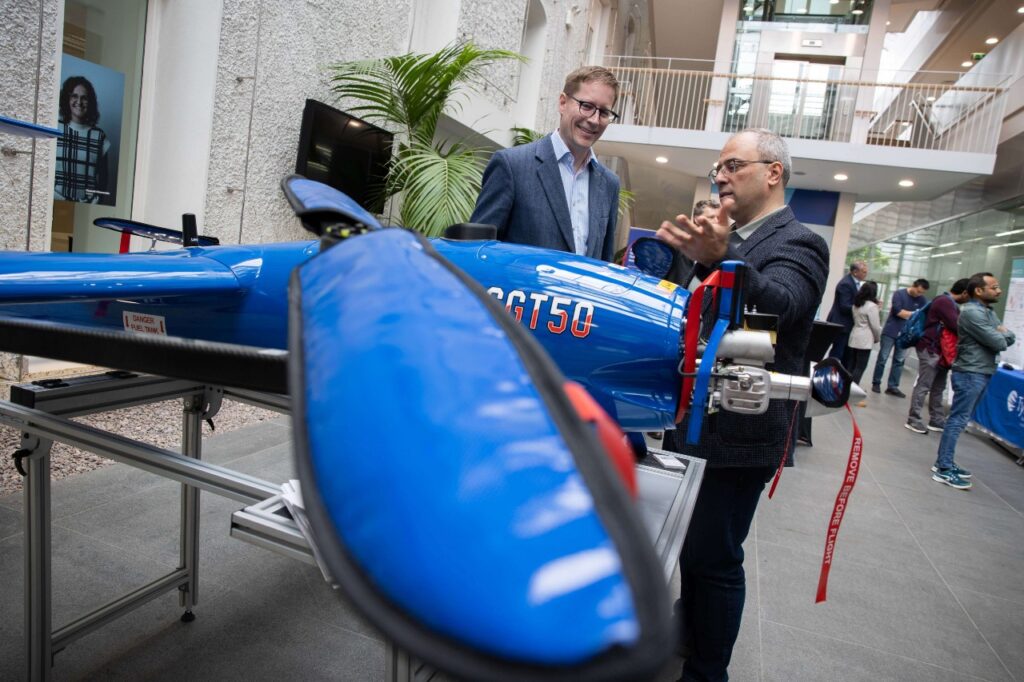
Professor Holger Claussen, Wireless Communications Laboratory, Tyndall said:
“This project has the potential to transform how Ireland and other countries survey their maritime space, while promoting Ireland as a leader in smart drones, future communications, AI, and virtual and augmented reality in harsh operating environments.”
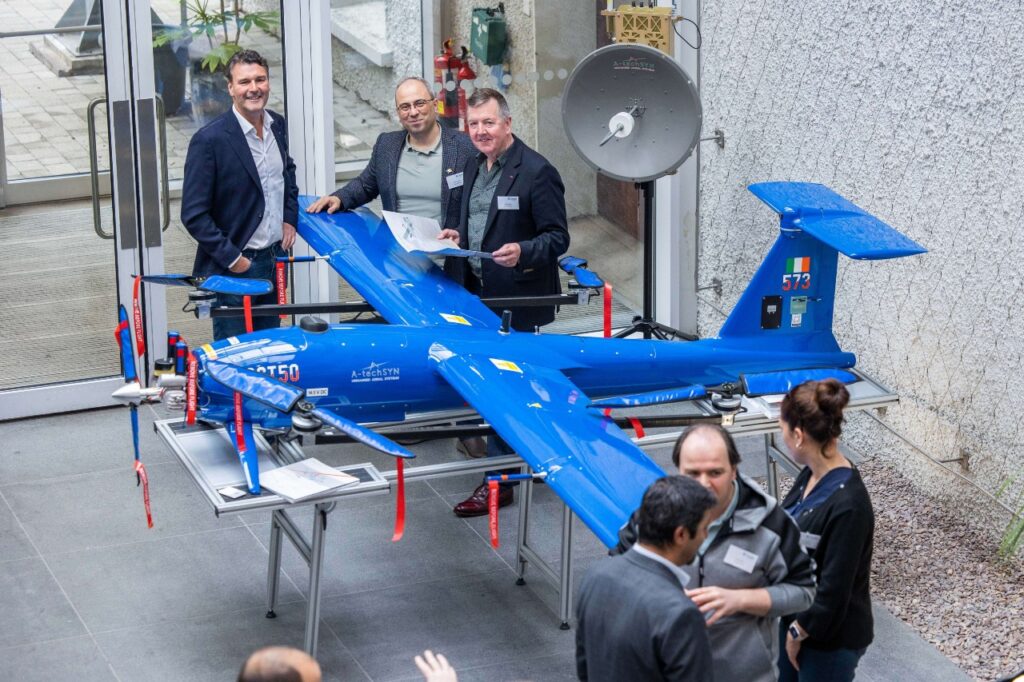
Vice Admiral Mark Mellett, former Defence Forces Chief of Staff, said:
“GUARD emerged from discussions with the team at Tyndall on how Ireland’s research and industry expertise could be applied to address the real-world challenges of maritime security. By bringing together operational knowledge and technological innovation, the project set out to strengthen maritime surveillance capabilities and support efforts to combat illicit activity at sea. Its success is a testament to the commitment, collaboration and expertise of all the partners involved.”
Gokhan Celik, CEO, A-techSYN said:
“DTIF projects like GUARD are vital in helping Irish SMEs translate research and innovation into market-ready solutions, demonstrating how public investment in collaborative R&D can create export opportunities. Working with Tyndall and our partners has strengthened our technology and expertise. As a direct result, we not only succeeded in demonstrations but also secured a multi-million-euro project with an overseas partner and submitted the relevant export licence applications. This is exactly the kind of commercial progress these programmes are designed to support: bringing Irish-developed technology to global markets while delivering economic and societal impact.”