

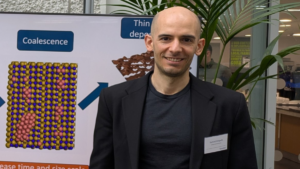
Tyndall National Institute is delighted to announce that Dr Samuel Aldana Delgado has been awarded a prestigious Research Ireland Pathway Programme grant for his project Digital Twin of Memristive Memory Design and Fabrication for Neuromorphic Computing (DigiMemNeuro). The award provides €665,448 to support a four‑year programme of research and postgraduate training.
This national initiative strengthens Ireland’s research talent pipeline by supporting outstanding postdoctoral researchers as they transition toward independent research careers. Each award funds an independent project and a postgraduate student, enabling early‑career researchers to build leadership experience and establish research independence.
About DigiMemNeuro
DigiMemNeuro aims to revolutionise how memristive memory devices, a core building block for neuromorphic computing, are designed, fabricated and optimised.
Neuromorphic computing offers parallel processing with dramatically lower power consumption. As demand for high‑performance computing and AI grows, energy‑efficient architectures are becoming essential for both technological progress and environmental sustainability.
Dr Aldana Delgado’s research will focus applying multi-scale simulation tools to design memristors that will be fabricated using atomic layer deposition (ALD) and advanced etching techniques. These devices have the potential to enable ultra‑dense, low‑power memory and computation for AI, edge devices, and large‑scale data processing.
Open Dataset to Accelerate Global Research
A major output of DigiMemNeuro will be a comprehensive, openly accessible dataset combining simulation and experiment results on new memristor devices. By sharing these important resources, the project will deliver on accelerating global progress in sustainable, high-performance computing.
Dr Samuel Aldana Delgado commented:
DigiMemNeuro aims to optimise memristive memory devices for neuromorphic computing by developing an open-source, multiscale simulation framework that advances how we design and fabricate them using ALD and precision etching. These devices have the potential to unlock massively parallel processing for next‑generation computing. Neuromorphic approaches will also help address urgent ecological challenges by dramatically reducing the power consumption associated with today’s energy‑intensive computing workloads.
Dr Michael Nolan, Head of Group – Materials Modelling for Devices at Tyndall, added:
The Research Ireland Pathway Program is critical for talent identification and development for future generations of internationally leading researchers and supports our ambitions for talent development as part of the new Tyndall 2030 strategy. Samuel’s Pathway award recognises his outstanding track record and high potential as a leading researcher on a topic that is vital for future sustainable and energy-efficient computing needs. The recruitment and training of a PhD student supports the development of human capacity ensuring a pipeline of excellent researchers into the semiconductor industry”
The Research Ireland Pathway Programme plays a key role in developing the next generation of research leaders. Tyndall is proud to host this cutting‑edge project and to contribute to national and international efforts to build sustainable, energy‑efficient computing technologies.