

As Tyndall enters a pivotal decade for Ireland’s semiconductor ambitions, a step change in innovation is shaping the Institute’s future.
Among the leaders driving this transformation is Dr Patrick Morrissey, Director of Innovation & Industry Engagement.
With over 30 years’ experience spanning industry-focused, innovation leadership, spin‑out creation, and nearly two decades advancing commercialisation at Tyndall and University College Cork, Patrick brings a distinctive blend of industry insight and research expertise to this role. Since stepping into the position, he has accelerated Tyndall’s innovation agenda, strengthening industry engagement and supporting the launch of three new semiconductor spin‑outs in 2025.
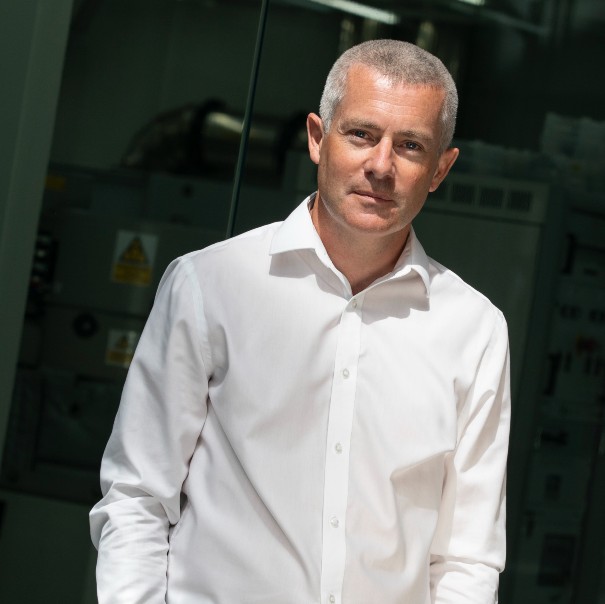
What is your current role?
As Director of Innovation and Industry Engagement, my role is to create the environment within Tyndall to commercialise our breakthrough innovations in partnership with industry (SMEs and multinationals), and through the formation of spin-out companies. This work is central to advancing our ambition to grow and strengthen Ireland’s semiconductor sector.
This includes securing and leveraging innovation-focused large-scale awards or investments, such as national research centres (iCHIPS and MCCI), EU funded Pilot Lines (FAMES, Nano-IC and PIXEurope), the national chips competence centre I-C3 and the ESA Business Incubation Centre (BIC) for Ireland.
What path led you here?
I spent the first 12 years of my career working in industry-focused, leadership innovation roles, working with multinationals and the creation of a spin-out company, followed by 18 years in innovation and commercialisation leadership positions across Tyndall and UCC. This combined experience and deep understanding of both environments helps me ensure that there is seamless engagement between Tyndall and our industry partners. This is essential to ensuring the successful advancement of our technologies from lab-based research to market deployment and delivering real economic impact.
What have been the highlights of your new role to date?
The positive response received from companies and interest in exploring how they can work with Tyndall going forward to achieve the ambitions set out in the Silicon Island strategy, particularly in scaling the semiconductor sector in Ireland and the EU. There is strong interest in building an independent supply chain within the EU. Also, there is strong momentum behind creating Ireland’s future semiconductor companies reflected in the launch of three Tyndall Spin-Outs in 2025, a significant early milestone.
What are your priorities for the next stage of Tyndall’s growth?
There are two, building a global R&D Innovation Hub with more than 30 companies in residence in Tyndall, not only collaborating with us, but also with each other, enabled through Tyndall North.
The second priority is the creation of ten or more new companies that will directly help scale the growth of Ireland’s indigenous semiconductor sector. We are seeing significant interest from industry-experienced individuals who are eager to engage in future Tyndall spin-outs, and potential investors. This growing pipeline of talent and capital will be critical to realising our ambition to launch ten companies that scale to HPSU (high performance start-up) status and contribute to Ireland’s long-term semiconductor competitiveness.
What long‑term impact do you hope to make in your role?
Lasting impact? It has to be Tyndall’s culture and ways of working, as such changes have a bigger and longer-lasting impact. If we can cultivate a culture where staff, students, and trainees feel genuinely empowered to translate their science into real-world solutions, then we create something far more powerful than a single breakthrough. We build a sustainable, self-renewing pipeline of innovation that continually delivers impact for Ireland and for global industry.
Did you have a role model who influenced your career choice?
There were a number and the common attribute with them was their leadership style (not management). Those who influenced me the most shared a common trait through their leadership style, not management – they led through empowerment rather than instruction.
They were all highly respected for their opinion, and rather than tell individuals what to do, they empowered and guided individuals, which led them to become more effective at their jobs and thereby strengthened the team and outputs. Success is not achieved by one single individual, no matter how good they are, but by a highly competent set of individuals who also work effectively as a team. Investing time in both the individuals and the team, is key to achieving this.
What advice would you give your younger self?
You should make career decisions that direct you towards the activities that you most enjoy, rather than focusing solely on the next promotion, this will come if you perform, which can only be achieved if you enjoy your work. You should also try not to over-engineer every step of your career. Opportunities often arise outside your control, so don’t be hard on yourself if things don’t unfold exactly as planned.