

Developing scalable approaches for advanced packaging and heterogeneous integration is a central focus of the FAMES pilot line. As a key partner in the pilot line, Tyndall National Institute researchers have demonstrated a novel tether‑free micro‑transfer‑printing (MTP) approach for integrating Si‑based micro‑inductors, targeting next‑generation Power System‑on‑Chip (PowerSoC) applications.
The work was presented by Dr Sambuddha Khan, FAMES Programme Manager, Tyndall, at the Electronic Components and Technology Conference (ECTC) 2026 in Orlando, Florida, one of the world’s leading forums for electronic packaging and heterogeneous integration.
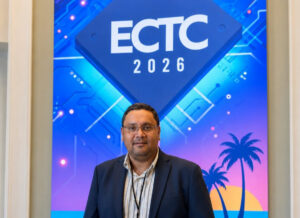
The research, titled “Tether‑Free Micro‑Transfer‑Printing of Si‑based Micro‑Inductors: Demonstration of on‑Glass and in‑Silicon Integration for PowerSoC Applications,” introduces an advanced MTP process for integrating high‑performance micro‑inductors across multiple platforms. It demonstrates tether‑free transfer printing for flexible, scalable device integration, alongside successful integration of Si‑based micro‑inductors on glass substrates, as well as in‑silicon integration for compact, high‑density system architectures. Together, these results provide a pathway toward the heterogeneous integration of passive components, a key requirement for future PowerSoC technologies.
The FAMES pilot line focuses on developing new ways to build more powerful and efficient electronic systems. In this context Tyndall’s work demonstrates that micro-transfer printing allows components to be combined and integrated with greater flexibility, helping to overcome current limitations in advanced packaging. This opens up new possibilities for designing smaller, more efficient systems, particularly for power applications, and marks an important step toward bringing these technologies closer to real‑world manufacturing.
Dr Sambuddha Khan commented:
By advancing micro‑transfer‑printing techniques for power‑focused applications, this work strengthens Tyndall’s role in delivering next‑generation integration solutions within the FAMES pilot line. It also supports the wider ambition of accelerating semiconductor innovation from research into practical use.
As part of the broader European Chips Act ecosystem, developments like this contribute to a more resilient and competitive semiconductor landscape in Europe, helping ensure that key technologies for future electronic systems can be developed and manufactured at scale.
Authors: Amit Tanwar, Muhammet Genc, Dr Liang Ye, Dr Rayan Bajwa, Dr Somnath Pal, Dr Iurii Efimenkov, Dr Ranajit Sai, Professor Cian O’Mathuna, Brian Corbett, Dr Sambuddha Khan