

Tyndall National Institute welcomes the European Commission’s proposal for a Chips Act 2.0, describing it as a decisive step in strengthening Europe’s semiconductor ecosystem and accelerating the transition from research excellence to industrial-scale capability.
The updated framework signals a major evolution in European policy – placing greater emphasis on demand-generation, industrialisation, resilience, and supply chain security – while reinforcing the critical role of research and innovation organisations in delivering real-world impact.
As Ireland’s national institute for semiconductors and a key European research and technology organisation, Tyndall is already deeply embedded in Europe’s semiconductor landscape. Through its leadership in pilot lines, competence centres, and industry collaborations, Tyndall plays a central role in bridging research, innovation, and industrial deployment across the semiconductor value chain.
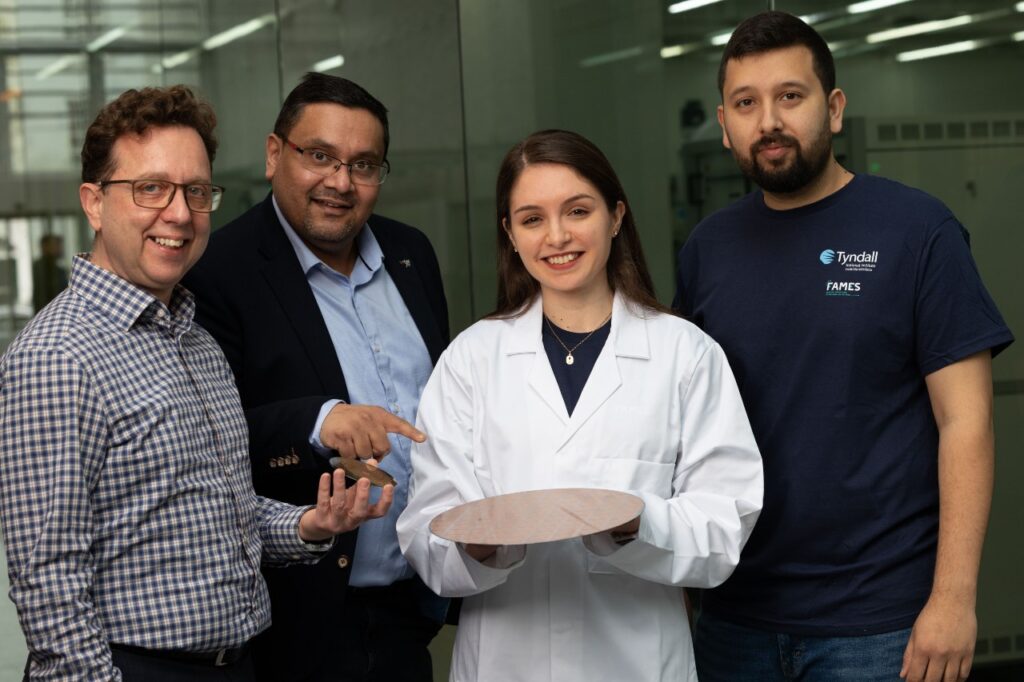
Tyndall’s 2030 Strategic Plan sets out a clear ambition to translate research excellence into scalable technologies, enterprises, and national capability, strengthening Ireland’s position at the heart of Europe’s semiconductor future.
Tyndall’s strategy aligns closely with the core objectives of Chips Act 2.0, including:
- Industrialisation of research
Supporting the critical “lab-to-fab” transition through pilot lines, prototyping, and system integration - Strengthening Europe’s innovation capacity
Advancing next-generation semiconductor technologies and enabling their deployment - Building talent pipelines at scale
Developing the skills required for Europe’s semiconductor ecosystem - Driving ecosystem coordination
Acting as a national and European convenor across research, industry, and policy
Professor William Scanlon, CEO, Tyndall, said
“Semiconductors underpin modern society and are critical to Europe’s economic resilience and technological sovereignty. Chips Act 2.0 represents an important step in strengthening Europe’s capability – from research through to production.
Tyndall is uniquely positioned to support this ambition. With expertise spanning the full materials-to-systems value chain and strong partnerships with industry and academia, we are focused on delivering real-world impact – translating research into technologies, companies, and skills that will sustain long-term competitiveness.”
Professor Giorgos Fagas, Director of Strategic Development, Tyndall, said
“Chips Act 2.0 marks a fundamental shift in Europe’s approach – from supporting research capability and capacity building to enabling industrial execution at scale. This is precisely the transition that Europe now needs.
At Tyndall, we see our role as a translation engine – connecting ideas with industry and converting innovation into manufacturable technologies and economic impact. Chips Act 2.0 reinforces the importance of this mission and creates the conditions for Europe to lead in key semiconductor domains, from heterogeneous integration and advanced packaging to disruptive materials-enabled innovation and system-level semiconductor technologies.”
The announcement of Chips Act 2.0 also reinforces Ireland’s role as a key driver of Europe’s semiconductor ambitions. Through national strategies such as Silicon Island and Tyndall 2030, Ireland is positioning itself as a global centre for semiconductor research, innovation, and talent development and core to Europe’s future success
Tyndall will continue to work with European and international partners to support the successful implementation of Chips Act 2.0 and to ensure that Europe translates policy ambition into sustained industrial impact, strategic capability, and global leadership.