

Tyndall National Institute has been named as the coordinating institution for Rinn Semiconductors, a major new national research centre announced today as part of a €460 million Government investment in seven Research Ireland “Rinn” centres. Tyndall is a partnership between the Department of Further and Higher Education, Research, Innovation and Science and University College Cork.
The announcement, made by Minister for Further and Higher Education, Research, Innovation and Science James Lawless TD, represents a step change in Ireland’s research and innovation ecosystem. Under the newly established Rinn network, the centres will drive coordinated, large-scale research programmes across strategically important sectors, including semiconductors, artificial intelligence, energy, and quantum technologies.
With a Research Ireland award of €71m, Rinn Semiconductors will be coordinated by Tyndall, reinforcing its position at the heart of Ireland’s semiconductor research and technology development landscape.

Rinn Semiconductors will focus on advancing heterogeneously integrated semiconductor systems, addressing the global challenge posed by the slowing of traditional chip scaling. The centre will pioneer chiplet-based design and advanced packaging technologies, enabling more powerful, efficient, and adaptable semiconductor systems.
The Centre Director is Professor Paul Townsend, Tyndall, and brings together a consortium of leading institutions:
- Tyndall National Institute
- University College Cork
- Trinity College Dublin
- Munster Technological University
- Dublin City University
- University of Galway
- University of Limerick
Through this collaboration, the centre will support principal investigators and co-applicants and train over 100 PhD researchers and up to 200 postdoctoral researchers, building a significant talent pipeline for Ireland’s strong semiconductor sector, which comprises 130 indigenous and multinational companies, supports 20,000 jobs and generates €13.5 billion in annual exports. Rinn Semiconductor will support the growth of this sector through the provision of ideas, technology and talent.
A key goal of Rinn Semiconductors is to build a connected “atom-to-systems” value chain in Ireland. By using Tyndall’s facilities and bringing together expertise from partner organisations, the centre will link early-stage materials research with system-level innovation and commercial applications.
Research will target three high-impact domains; Future Internet technologies, sustainable energy and environmental systems, and digital healthcare solutions.
This approach is designed to accelerate the translation of research into real-world technologies, supporting Ireland’s economic competitiveness and technological sovereignty.
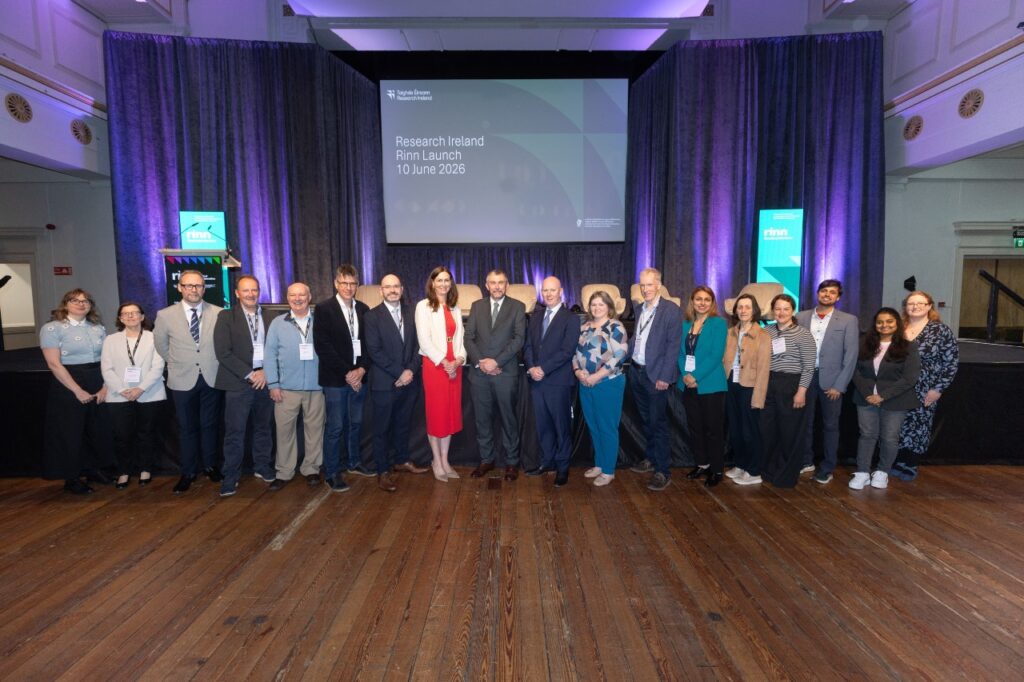
Professor Paul Townsend, Centre Director, said:
“Rinn Semiconductors represents a once-in-a-generation opportunity to redefine how we design and build hardware and smart systems. By advancing chiplet-based architectures, through heterogeneous integration and advanced packaging, we are moving beyond the limits of traditional scaling and opening up entirely new pathways for performance, efficiency, and functionality. This centre brings together exceptional expertise from across Ireland, and by working collaboratively through Tyndall’s facilities, we will create a truly integrated research ecosystem that can deliver impact from fundamental science through to real-world applications in communications, healthcare, and sustainable technologies.”
Speaking on the announcement, Professor William Scanlon, CEO, Tyndall, said:
“We are proud to lead Rinn Semiconductors at a time when semiconductor innovation is critical to global technological progress. This centre will build on Tyndall’s and our partner institution’s long-standing strengths in microelectronics and photonics, while fostering unprecedented collaboration across Ireland’s research system. By connecting materials, devices, and systems research, and aligning closely with industry partners, we aim to position Ireland as a global leader in next-generation semiconductor technologies.”
The establishment of Rinn Semiconductors aligns closely with the Government’s ‘Silicon Island’ National Semiconductor Strategy, as well as Impact 2030, the European Chips Act and Tyndall’s Strategic Plan 2030.
In addition to leading Rinn Semiconductors, Tyndall will play a significant collaborative role across several other Rinn centres, including Rinn Artificial Intelligence, Rinn Pharma & Biopharma, and Rinn Medical Devices.
Dr Paul Galvin is a co-applicant and theme lead for Digital Heathtech in RINN Artificial Intelligence. There are six other Tyndall PIs in this centre; Brendan O’Flynn, Conor O’Mahony, Daniela Iacapino, Holger Clausen, Lester Ho and Salvatore Tedesco. Dr Paul Galvin is also the sole Tyndall PI for Rinn Pharma & Biopharma.
This cross-centre involvement highlights Tyndall’s multidisciplinary strengths and its central role in enabling convergence between semiconductor technologies and application domains such as healthcare, data science, and advanced manufacturing.