

Researchers from Tyndall National Institute presented and published three papers at the European Semiconductor Technology Conference (ESTC) 2026, showcasing advances in photonic packaging, co-packaged optics and chiplet integration technologies.
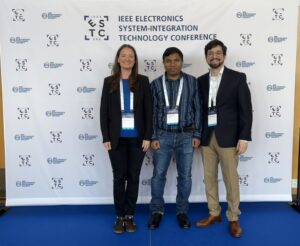
The contributions highlight Tyndall’s continued leadership in advanced packaging and heterogeneous integration, with the work also supporting activities within the PIXEurope Pilot Line.
Showcasing Advances in Photonic Packaging
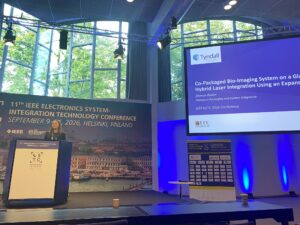
Dr Sharon Butler, Senior Researcher, presented a paper titled “Co-packaged Bio-imaging System on a Glass Interposer by Hybrid Laser Integration Using an Expanded Beam Approach.”
The work, carried out as part of the PhotonicLEAP project, demonstrates a compact bio-imaging system that integrates photonic and electronic components on a glass interposer. By combining advanced optical alignment techniques with glass-based packaging technologies, the research shows how highly integrated photonic systems can be manufactured with the scalability required for future healthcare and sensing applications.
In addition to presenting her paper, Dr Butler participated in an expert panel discussion on “Emerging Substrate Technologies – Innovating for AI Driven Applications.” The session brought together industry and research leaders to discuss how substrate technologies are evolving to meet the increasing performance, power and thermal management requirements of next-generation AI systems.
Silicon Interposer Technology for Chiplet Integration
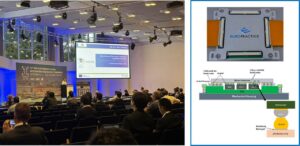
Dr Arun Kumar Malik, Senior Engineer, presented a paper titled “Silicon Interposer Technology for Advanced Chiplet-Based Packaging,” which explores a standardised 2.5D chiplet integration framework. This work is part of the Europractice chiplet integration service. The proposed approach enables high-density electrical interconnections while facilitating rapid prototyping and cost-effective, modular system development. These characteristics make the proposed technology well suited to research applications and to small and medium-sized enterprises (SMEs), where flexibility, scalability, and reduced development costs are important considerations.
Advancing Photonic Packaging for Cryogenic Applications
Robert Bernson, PhD Student, presented “Cryogenic Edge-Coupling Packaging Method of Photonic Chips Using Annealed Adhesive.”
The research investigates a photonic packaging approach designed for cryogenic environments, using annealed adhesive materials to improve the reliability and performance of optical chip coupling at low temperatures. The work supports the development of advanced photonic systems for emerging quantum and cryogenic computing applications.
Professor Peter O’Brien, Director of Advanced Semiconductor Packaging Research, Tyndall, commented:
The future performance of electronic and photonic systems will increasingly depend on advances in packaging and integration. The research presented by our team at ESTC 2026 demonstrates Tyndall’s commitment to developing scalable packaging technologies that bridge the gap between research, manufacturing, industry and innovation. Our strong presence at this year’s conference reflects Tyndall’s growing international profile and its position as a leading European research centre in advanced semiconductor packaging and heterogeneous integration, reinforced by its leading role in major European pilot lines and initiatives focused on accelerating the transition of advanced technologies from research to industrial manufacturing.